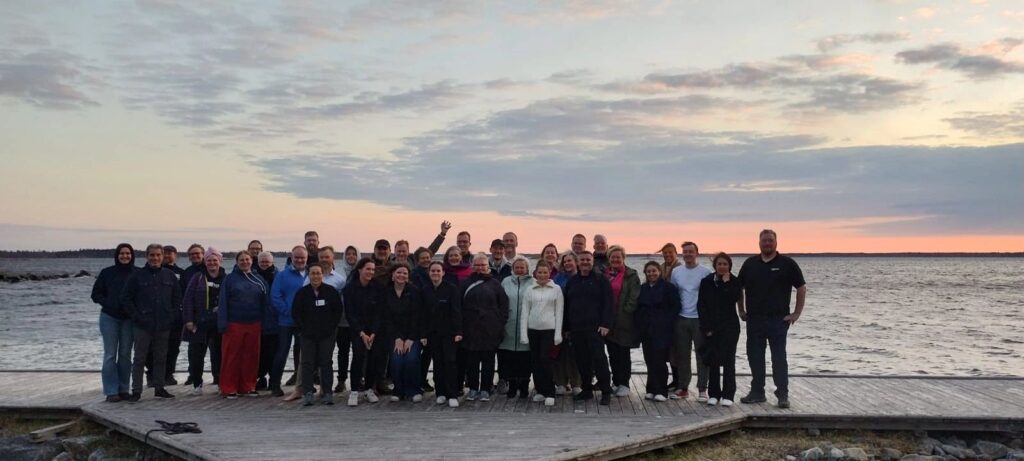
The fourth CaBatt course took place between April and May 2025 in Vaasa, Finland, hosted by Vamia Vocational College in collaboration with regional industry partners. The event brought together around 30 vocational educators from diverse disciplines across Europe—including participants from Finland, Sweden, Norway, Iceland, Germany, the Czech Republic, Slovenia, and Portugal—for an intensive training programme on Battery Raw Materials and Recycling.
A Two-Phase Learning Experience
The training combined online and in-person learning, offering participants a comprehensive understanding of the battery value chain, from raw materials to recycling.
Phase 1: Online Learning (April 2025)
Over four weeks, educators engaged in live webinars, interactive discussions, and self-paced study modules. The online sessions covered:
- Fundamentals of battery operation and manufacturing
- Raw material sourcing, refining, and processing
- The EU Battery Directive, recycling technologies, and the emerging battery passport
- Key topics such as circular economy principles, industrial safety, and English for the battery sector.
Expert lecturers from ATEC and Vamia, along with guest lecturers from KPEDU – The Federation of Education in Central Ostrobothnia, led the sessions, providing deep insights into battery fundamentals, materials, mineral processing, and recycling.
Phase 2: In-person Training in Vaasa (13–15 May 2025)
The second phase brought participants together in Vaasa for three days of immersive, practical training. Educators met with industry experts from GigaVaasa, T1 Epsilon, Epsilon Advanced Materials, Fortum, and Aalto University, exploring the future of battery materials and technologies.
A highlight of the programme was a visit to KIP – Kokkola Industrial Park, the largest inorganic chemical industry ecosystem in Northern Europe, home to battery materials companies such as Jervois, Keliber Sibanye-Stillwater, and Umicore. Participants also gained insight into the Finnish Vocational Education and Training (VET) system through study visits to Vamia’s learning environments.
Outcomes and Recognition
Participants who successfully completed both phases received a digital badge recognizing their achievements and new competencies. This certification empowers vocational educators to bring up-to-date industry knowledge into their classrooms and strengthen the connection between education, innovation, and the green transition.
Beyond technical expertise, the course fostered international collaboration and networking, reinforcing a European community of educators dedicated to sustainability and the future of the battery industry.