
CABATT RESULTS
Company Speakers in CaBatt Events
Companies, experts, and institutions contributing to CaBatt training courses and events across Europe.
🇳🇴 Norway
Corvus Energy: Kristin Sand Bakken (Innovation Manager), Henning Dahl (SVP Aftermarket & Digital), Kjetil Dent Tranberg (SVP Commercial Products), Lars Ole Valøen (EVP/CTO – company visit).
Bergen Fire Department: Kurt Rusås (Fire Constable/Smoke Diver).
Field trip: Battery-driven ferry MF Kommandøren.
NORCE: Geir Nævdal (Research Professor, Future of Batteries in Maritime Sector).
Fagskule Vestland: Meritime simulators and education.
🇸🇪 Sweden
Northvolt: Helen Rönnqvist (HR) – presentation and site visit.
VUX: Adult education centre & training labs for battery industry.
FESTO Didactic: Stefan Johansson (Festo LX Portal).
Sara Culture House: Patrik Sundberg (Skellefteå Kraft) – battery energy storage systems.
ACE – Arctic Centre of Energy: Tobias Vahlne.
🇵🇹 Portugal
Battery Cluster Portugal: Fernando Machado (General Manager).
ATEC: Learning environments for stationary batteries & EVs.
EDMTECH: Paulo Alves (CEO).
Exide: José Barreiros (Director R&D Energy Solutions) – presentation and site visit.
EDP Electricity Museum: Energy transition & sustainability.
DST Solar: Andre Pintos (Project Manager, Renewable Energy Communities).
CALB: Sherry Wei (General Manager, CALB Europe).
🇫🇮 Finland
KPEDU: Teemu Mäkinen & Nea Pitkäkangas (Mineral Processing).
GigaVaasa / Energy Vaasa: Marko Kuokkanen.
Freyer Batteries: Tomi Vuollet (T1 Energy).
Epsilon Advanced Materials: Heli Rasimus.
Umicore Finland Oy: Kim Sundell (EHS Manager).
KIP – Kokkola Industrial Park: Kaisa Kaapo (Executive Director).
Jervois Finland: Juha Järvi (Technical Director).
Keliber / Sibanye-Stillwater: Asko Saastamoinen (Head of HR).
Fortum: Peik Ekman (R&D Manager, Battery Recycling).
Aalto University: Sara Pakseresht (Postdoctoral Research Fellow).
Vamia: Sustainability & learning environments in Batt Forum.
🇨🇿 Czech Republic
VSB–Technical University of Ostrava: Simona Jursova (lectures).
TU Graz: Georg Macher (Battery Systems Engineering).
IT4Innovations Centre: Innovation & Supercomputing.
Centre for Advanced Innovation Technologies (CAIT): Mobility Lab, Smart Factory, eHealth Lab.
Dolní Vítkovice: Steel factory site visit.
Hyundai: Production site visit and technical discussions (Quality, Process Engineering, HR).
Moravian-Silesian Technological Academy (MTA): Martin Kavan (Team Leader, Future Mobility).
Automotive Skills Alliance (ASA): Josef Tichánek (Battery Passport Lecture, PIECE project).
Description of the Courses - the Course Model
CaBatt Course Structure
Model for Erasmus+ Courses for VET Teachers and Trainers
Overview
Each CaBatt course focuses on a specific part of the battery value chain and combines online and physical training for VET teachers, trainers, and education professionals. The goal is to strengthen skills, share knowledge, and promote collaboration between education, research, and industry.
General Course Structure
- 📘 Part 1 – Online Training (approx. 16 hours) • 2 live webinars (2 × 4h) + 8 hours of self-study. • Delivered via Microsoft Teams and the Skills Learning Platform. • Focus: Fundamentals of the battery value chain, terminology, and key industrial processes.
- 🏫 Part 2 – Physical Course (3 days) • Conducted in the hosting country (e.g., Finland, Czechia, Portugal...). • Includes lectures, workshops, networking, and company/site visits. • Participation of ~30 European VET teachers and trainers.
- 🎓 Certification • Completion of both parts is required for a digital badge and certificate. • Recognized as part of the Erasmus+ mobility framework.
Learning Objectives
- Understand the battery market, value chain, and key processes.
- Explain the Battery Directive and sustainability principles.
- Gain insight into industrial technologies and workplace safety.
- Strengthen teaching methods for battery-related topics.
- Develop international collaboration and English communication skills.
Course Delivery and Support
- Language of delivery: English
- Platform: Microsoft Teams and Learning Platform
- Trainers: Experts from VET, academia, and industry
- Participants: Experienced VET professionals in technical fields
- Equipment: Personal computer with internet access and headset
Logistics & Funding
- Participation in both parts is free of charge.
- Travel, accommodation, and meals are covered by participants (often through Erasmus+ mobility funding).
- Each course host provides detailed travel and accommodation guidance.
- Participants receive access to all course materials and resources.
Courses for Teachers and Trainers
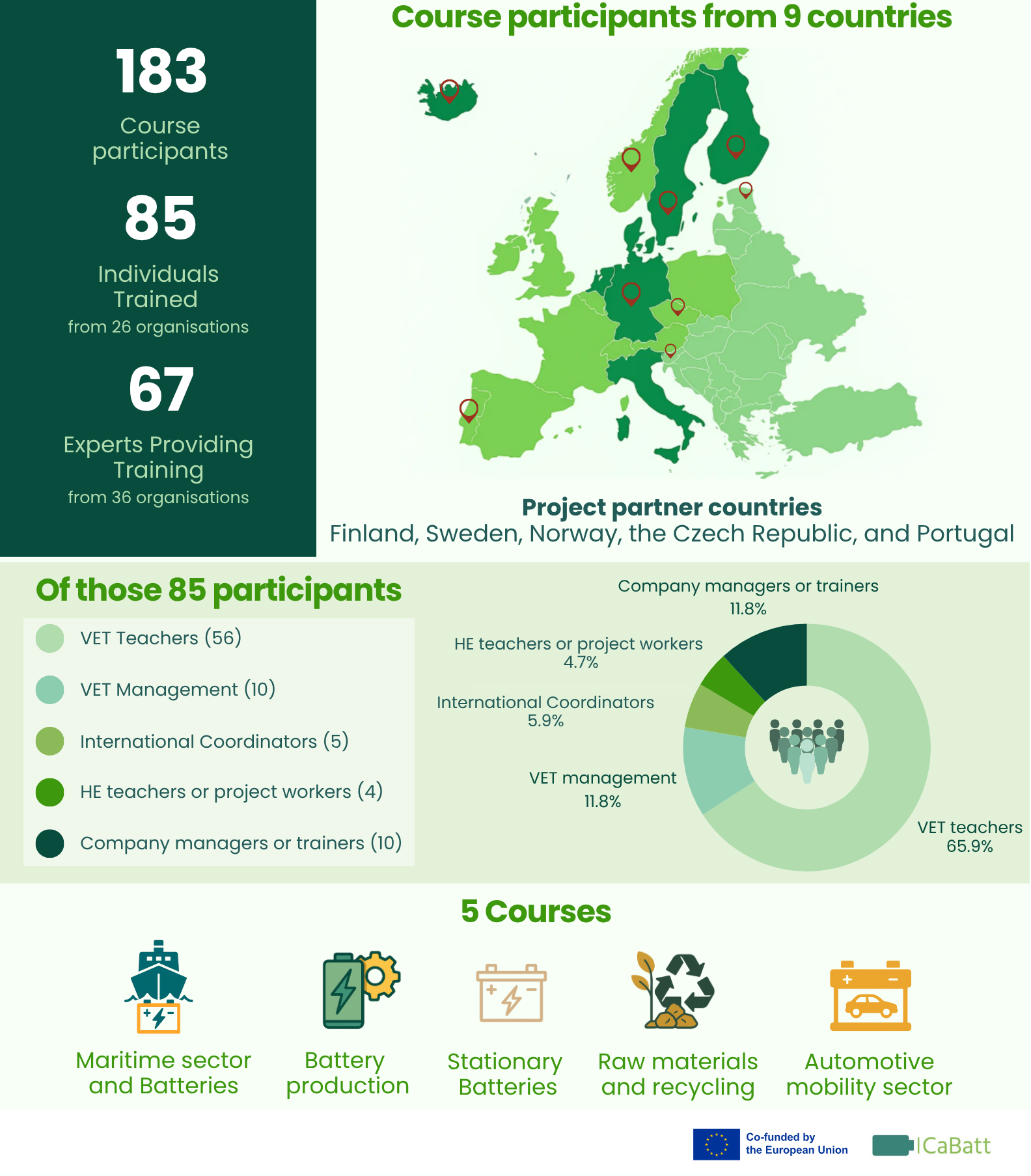
The project developed and delivered five high-quality courses consisting of online preparatory sessions and a three-day in-person event (the BaTT Forum). The online component of each course was designed in accordance with the quality standards for Erasmus+ individual courses and was provided prior to the in-person event. Its purpose was to equip participants with the necessary background knowledge, including relevant English terminology, to fully understand the content presented during the forum.
All courses were made available to participants through the Automotive Skills Alliance Learning Platform.
Automotive Skills Alliance Learning Platform
Course 1 – Maritime Sector and Batteries
November–December 2023 · Bergen, Norway
Online + 3-day face-to-face event (12–14 December 2023) with lectures, workshops, and company visits for 30 VET teachers across Europe.
Learning Outcomes
- Explain the battery market and value chain.
- Describe how batteries work and basic vocabulary.
- Understand maritime battery applications and safety aspects.
- Recognize educational challenges in the sector.
- Apply English and multicultural skills in an international setting.
Course 2 – Battery Production
April–May 2024 · Skellefteå, Sweden
Online + 3-day face-to-face event (21–23 May 2024) with workshops and company visits for 30+ VET teachers.
Learning Outcomes
- Explain the battery market and production steps.
- Describe lithium-ion production and related safety aspects.
- Understand learning environments and training tools for production.
- Recognize educational challenges through peer networking.
- Apply English and multicultural communication effectively.
Course 3 – Stationary Battery Applications
October–November 2024 · Palmela, Portugal
Online + 3-day face-to-face event (19–21 November 2024) including company visits and workshops.
Learning Outcomes
- Explain Battery Energy Storage (BES) and its safety aspects.
- Recognize BES technologies and future developments.
- Understand learning environments for stationary applications.
- Identify educational challenges in the BES field.
- Apply English and multicultural skills internationally.
Course 4 – Raw Materials and Recycling
April–May 2025 · Vaasa, Finland
Online + 3-day face-to-face event (13–15 May 2025) with lectures, workshops, and company visits.
Learning Outcomes
- Explain raw material sourcing, refining, and recycling basics.
- Understand the Battery Directive and producer responsibilities.
- Recognize future developments in materials and recycling.
- Understand workplace safety in this sector.
- Engage with peers on educational challenges.
- Apply English and multicultural skills internationally.
Course 5 – Automotive Industry and Batteries
September–October 2025 · Ostrava, Czech Republic
Online + 3-day face-to-face event (1–3 October 2025) with lectures, workshops, and company visits.
Learning Outcomes
- Explain the automotive battery value chain.
- Understand cybersecurity and safety standards (e.g. ASPICE).
- Recognize Lifecycle Assessment (LCA) principles.
- Gain insights into e-mobility technologies and R&D.
- Adapt vocational curricula for green and digital transitions.
- Network on educational challenges across sectors.
The Learning Platform - Moodle Course
[Course Title]
[Project / Network Name] | Teachers & Trainers Forum | Course Structure Overview
Welcome to the course on [course theme]. This blended training combines online activities with a face-to-face component, designed for VET teachers, trainers, and education professionals. Participants complete structured online modules before joining an in-person session with lectures, workshops, and company visits.
Activity 1 – [Activity Title]
Date: [Insert date or timeframe] | Format: [Webinar / Workshop / Self-study] [Brief description of what the activity covers and its purpose. Mention delivery tool if relevant, e.g. “Delivered via Teams and Learning Platform.”]- 📘 [Main learning objective or topic]
- 🔗 [Linked file, SCORM, or interactive activity]
- 🗣️ [Feedback form or reflection task]
Activity 2 – [Activity Title]
Type: [Self-study / Assignment / Group Work] | Due [date] [Description of this module’s purpose, e.g. “Interactive content to introduce core terminology and sustainability concepts.”]- 🧩 [Interactive exercises / quizzes / assignments]
- 🔄 [Optional external resource or registration link]
- 🗣️ [Feedback form – short reflection]
Activity 3 – [Activity Title]
Date: [Insert date] | Format: [Live webinar / Group session] [Short summary of what participants will do — e.g., “Experts present case studies and facilitate discussion on real industry applications.”]- 📂 [Downloadable materials or presentations]
- 🎥 [Video or recording links]
- 🗣️ [Feedback form – evaluation of live session]
Activity 4 – [Preparation / Safety / Assessment Module]
Type: [Self-paced / Assignment] | Due [date] [Describe any preparatory requirements or assessments before the physical event, such as safety induction or pre-visit reading.]- 🦺 [Mandatory pre-visit module]
- 📑 [Short assessment or certification requirement]
- 🗣️ [Feedback form – pre-event reflection]
Activity 5 – Face-to-Face Event
Dates: [Insert dates] | Location: [City, Country] [Brief description: lectures, workshops, and company visits focusing on applied learning and networking among participants.]- 🏭 [Industry visits and case studies]
- 👥 [Workshops and peer learning sessions]
- 📷 [Upload space for event photos or materials]
- 🎓 [Digital badge and certificate awarded after completion]
Overall Feedback
After completing the course, participants are invited to provide feedback on both the online and in-person parts of the course to help improve future editions.- 📝 Overall feedback form (available after course completion)
- 💬 Optional reflection on learning outcomes and next steps
Micro-credentials - Digital Badges
Digital Badges – Course Completion
Issued through Skills Hub micro-credentials platform

Eligibility for Badge Issue
✅ Attending both pre-webinars
✅ Completing the online course in Moodle (exercises and assignments according to completion criteria)
✅ Attending the face-to-face event
Badge Structure & Learning Outcomes
One digital badge is issued per achieved learning outcome. Each badge represents a verified competence gained through course participation and assessment.
🔹 Knowledge & Awareness of Battery Value Chain
🔹 Understanding of Industry Processes & Safety
🔹 Application of Pedagogical and Collaboration Skills